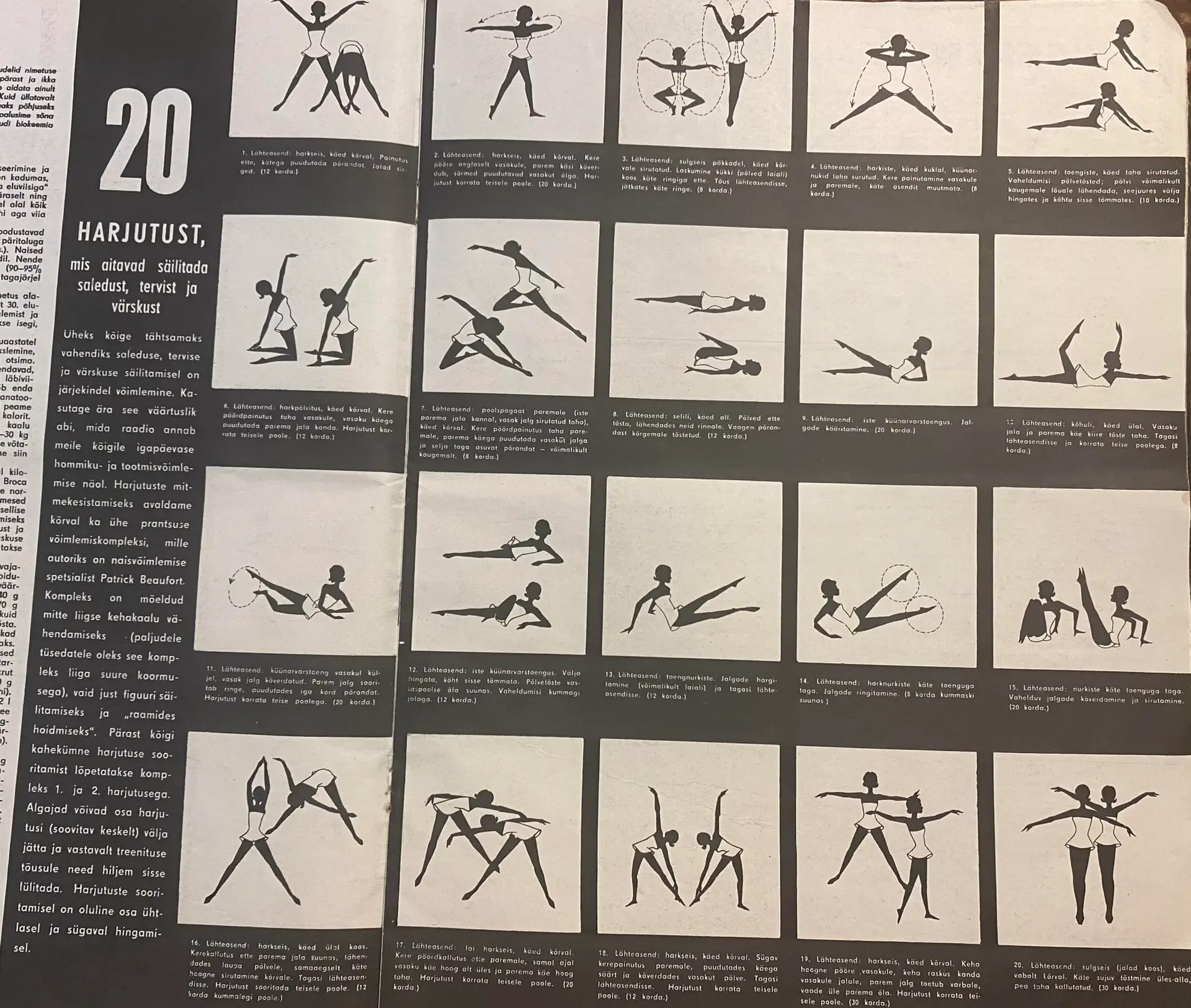

Let’s take a look at what fashion magazines said about weight gain 60 years ago. The following article comes from the 1961 magazine “Siluett” and was published under the title “Weight Gain”.
The editorial office receives many letters from readers for whom our designs labelled “for the fuller figure” are intended. These letters express a great deal of concern about weight gain and repeatedly ask the same question: what can be done? If the weight gain is caused by illness, only a doctor can help, as abnormal weight gain can have many different causes. Surprisingly, however, many people never seem to consider that the most common cause of obesity is simply eating too much. We invited E. Vagas, Candidate of Pharmaceutical Sciences and head of the Biochemistry Division at the Institute of Experimental and Clinical Medicine of the USSR Academy of Medical Sciences, to explain how excess weight can be avoided.
Work processes are being mechanised and automated throughout every branch of production in our country. Heavy physical labour requiring a great deal of energy is disappearing and is increasingly being replaced by mental work. The number of people with a so-called “sedentary lifestyle” is steadily rising. At the same time, food is being produced systematically and at an ever-increasing rate. In the near future, all our needs in this area will be met. Fully meeting all the body’s needs must not, however, lead to overindulgence in food.
Overeating on the one hand and a lack of physical work on the other contribute to weight gain. Excess weight is sometimes caused by illness, such as disorders of the endocrine glands or central nervous system. Women often gain weight after giving birth or during menopause. The treatment of these medical conditions is the responsibility of a doctor. In most cases, however—90–95% of them—weight gain is caused by overeating. Weight gain resulting from overeating can develop into a disease: obesity.
Weight gain usually occurs between the ages of 30 and 40 because, after the age of 25, a person’s metabolic rate falls by 7–8% every ten years. People often give up sport after turning 30. Morning and workplace exercises, as well as spending time outdoors, are regarded as a waste of time. Some people even believe that gaining weight is not a problem at all, but a sign of good health and respectability.
The “fruits” of such an attitude do not take long to appear. By the ages of 40–50, disturbances in the body’s functions—shortness of breath, heart palpitations, an increased pulse rate, metabolic disorders and so on—may already force people to seek medical help. The number of people who damage their health and shorten their lives through overeating is on the rise. Based on their research, scientists in the German Democratic Republic concluded that “every third person there eats themselves ill”. Overindulgence in food also occurs in our country. For example, the food served in our sanatoriums sometimes contains an average of 4,600 calories a day, while we estimate a cosmonaut’s energy needs during space flight at 2,700 calories. Thin people at a sanatorium need to restore their normal weight. It is not right, however, for people whose body weight is already 10–30 kg above normal to gain another 3–4 kg while staying at a sanatorium or rest home. These matters must be understood correctly because the issue is not merely the “waistline”, but first and foremost health.
What, then, is a person’s normal weight? Normal body weight in kilograms is calculated by subtracting 100 from height in centimetres—the so-called Broca formula. This calculation works well for a person who is 165 cm tall and whose normal body weight is therefore 65 kg. In reality, shorter people are somewhat heavier and taller people somewhat lighter than the weight produced by this calculation. More precise normal body weight is determined using tables that take sex, age and body type into account as well as height. A variation of 4 kg below or above the ideal average weight is also considered normal. Larger deviations are described as underweight or overweight.
Avoiding weight gain or losing weight requires self-discipline above all, but some knowledge is also needed. Not all foods are equally “dangerous” when it comes to gaining weight. For example, the following amounts have the same nutritional value, each containing 100 calories: 11 g of pork fat, 13 g of butter, 40 g of bread, 80 g of beef, 100 g of potatoes, 150 g of milk, 150 g of cod, 170 g of apples, 400 g of cabbage and 1,200 g of cucumber. Eating vegetables or fruit and protein-rich but low-fat varieties of fish and meat does not easily increase body weight. By contrast, fatty meats such as pork fat and carbohydrate-rich foods such as bread, white bread and porridge are readily converted into stored fat in the body. Sugar and sweets—candies, chocolate, biscuits and so on—also promote weight gain. People who are overweight should therefore limit their consumption of these foods. For example, it is recommended that no more than 20 g of butter and 50 g of sugar be consumed per day. The daily diet should, however, contain at least 15–20 g of vegetable oil, which contains essential unsaturated fatty acids—vitamin F. People who are overweight should also limit their water intake, which should not exceed 0.8–1.2 l per day. Limiting fat and carbohydrates—starch and sugar—does no harm when leading a sedentary lifestyle; instead, it helps the body gradually use up its excess fat stores. Moreover, as a result of metabolic processes in the human body, starch and sugar can be converted into fat, while fat and protein can be converted into sugar—glycogen. Proteins can also be converted into fat.
When regulating body weight, protein intake—the requirement is 100–150 g per day—must not be restricted because protein increases the body’s metabolism and cannot be replaced by any other nutrient. The diet should therefore contain sufficient amounts of low-fat meat, fish, cheese, curd cheese and similar foods. Food must also be rich in vitamins and minerals because these nutrients cannot be replaced by others. Vegetables and root vegetables are important sources of vitamins and minerals. These foods contain little table salt—sodium—and are relatively rich in potassium. Potassium and sodium regulate the body’s water balance: sodium retains water in the tissues, while potassium helps remove it from the body. Potassium-rich vegetables and fruit therefore help the body get rid of excess water.
Research in recent years shows that demanding mental work requires more protein, vitamins and phosphorus than physical work. A person who does mental work and leads a sedentary lifestyle should therefore consume fewer foods rich in fat and carbohydrates, but more foods rich in protein, vitamins and phosphorus.
Weight gain can be tackled successfully only by limiting excessive food intake and increasing the body’s energy expenditure through more vigorous movement. Self-discipline is more important here than medicine. Keep an eye on your body weight because gaining weight means ageing prematurely.
