
Did you know that intense exercise keeps you young? You’ve probably noticed that people who have put more effort into their workouts look younger. Is it because they have a smaller waist circumference? A slimmer waist certainly influences how old a person appears, but in reality, youthfulness begins at the cellular level. Science confirms that by exercising intensively, it’s possible to look up to 10 years younger than your actual age.
A study conducted at Brigham Young University examined 6,000 people aged 20 to 84 and concluded that people who are regularly highly physically active have significantly longer telomeres than those with a more sedentary lifestyle or those who exercise at a much more moderate intensity.
Hearing about these long telomeres probably reminded some people of a scene from *The Love for Three Oranges*, where Pantalone reads with great excitement the Paukson family’s astrological guide and tries to figure out what this “jalaa-labaa” is all about. “What on earth are telomeres?” is probably what many people who got a five in biology class are asking themselves now.
In short, telomeres are the nucleotide ends of our chromosomes. They act like our biological clock and are closely linked to age; every time a cell divides, we lose a tiny bit of these ends. Therefore, the older we get, the shorter our telomeres become.
However,
this study found that this shortening occurs more slowly in people who exercise intensely, so it’s safe to say that intense exercise keeps us younger, and the cells of those who exercise intensely appear nearly 10 years younger than their actual age.
What is considered intense exercise?
The fact that “intensity” is a highly relative concept becomes particularly clear when you read the social media posts of members of the Riigikogu about how hard and intense their work is, and then compare that to the image of empty rows of seats in the chamber.
For the purposes of
this study, “intense exercise” is defined as at least 30–40 minutes of exertion at least five times a week, with an intensity equivalent to at least that of running. This is actually slightly more than the upper limit of the WHO’s physical activity recommendations. The WHO recommends 75–150 minutes of vigorous physical activity per week for adults.
A 30-minute walk after breakfast is therefore not enough exercise to achieve this positive effect. Of course, morning walks have all sorts of other pleasant benefits: they burn calories, create a pleasant, meditative “flow” state, and help your dog feel lighter. So you don’t have to skip your morning walk, but unfortunately, it doesn’t count as a substitute for a workout.
But let’s take a moment to look at this from a slightly non--scientific and ask some great trainers—who generally don’t observe people at the cellular level or through a microscope—why you should add intense workout sessions to your daily routine?
Britta Alep, Nike’s head coach for the Baltics, recommends adding high-intensity workouts to your training plan to ensure well-rounded development. For example, if a person is used to training at a lower intensity and their body has already adapted to the workload, they should gradually incorporate more intense workouts into their routine.
"The emotional aspect plays a key role in why it’s worth challenging yourself with HIIT workouts from time to time. The sense of effort and the release of so-called ‘feel-good’ hormones are sure to make you feel great, which brings a sparkle to the eyes of a dedicated athlete,” says Alep, summarizing his reasons why intense training is beneficial.
Recommendations and Summary
Get at least 30 minutes of active exercise every day—enough that you start sweating by the end of your workout.
If you want to look younger than your actual age, go to the FitQ video catalog, select the “Cardio” or “HIIT” categories, and click “Play.”
Read more
The full study in the journal Preventive Medicine: https://www.sciencedirect.com/science/article/abs/pii/S0091743517301470
A brief summary as a news article on the BYU website: https://news.byu.edu/news/high-levels-exercise-linked-nine-years-less-aging-cellular-level
WHO Physical Activity Guidelines: https://www.who.int/news-room/fact-sheets/detail/physical-activity
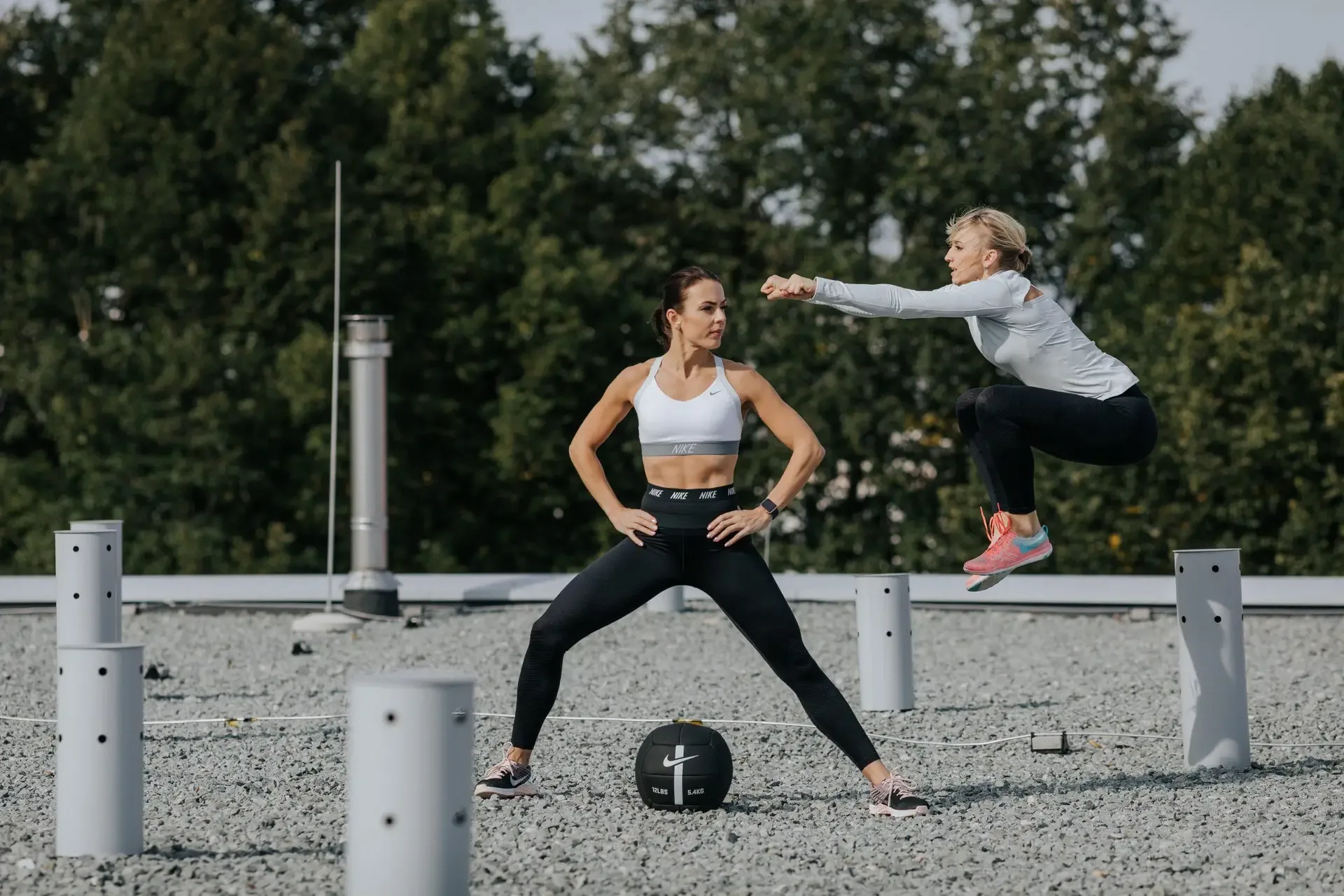
Cover photo: Gerry Sulp. Pictured are trainers Britta Alep and Sandra Raju.
